
Free Quote
Get Your Free Off-Grid RV Quote Here.
No obligation. No sales pressure. No hidden fees.
The Problem
Off-Grid Solar for RVs and Campers in Canada
Fuel costs, noise complaints, and quiet hours that shut you down at 10pm. There's a better way to power your rig.
If you've spent any time on crown land or in a provincial park without hookups, you already know the problem. The batteries are fine day one. By day two you're watching the voltage, rationing the fridge, and debating whether to fire up the generator.
A properly sized solar system with a decent lithium battery bank fixes that permanently. Most Canadian RVers who make the switch say the same thing: they wish they'd done it sooner.
We design and install complete off-grid solar systems for RVs, campers, travel trailers, and motorhomes across Manitoba, Saskatchewan, and Ontario. As an authorized Victron Energy dealer we use equipment built to handle Canadian winters, shaded forest sites, and years of road vibration.
Gallery
Our Past Off-Grid RV Installation Work
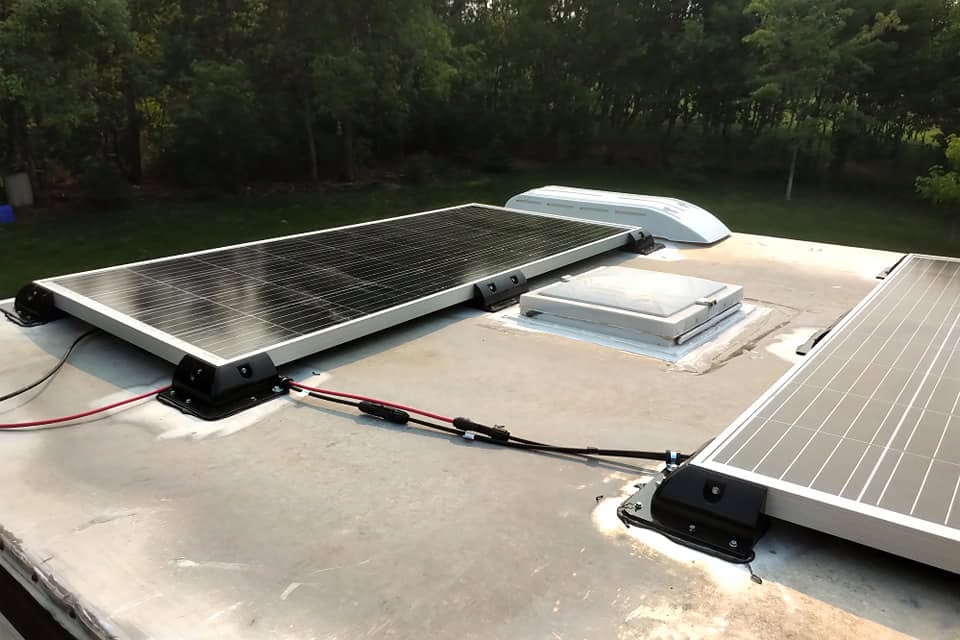
Real Off-Grid RV solar panel and system installation jobs we've done and helped design all over Manitoba and surrounding provinces.

Everything Included
What's in a Complete RV Solar System
Here's what goes into a properly built system and why each component matters.
We install monocrystalline panels for most RV builds. For curved surfaces or limited clearance we use semi-flexible panels. All panels are rated for Canadian temperature swings, UV exposure, and road vibration.

Lithium iron phosphate batteries are the right call for Canadian RVers. They handle deep discharge and fast charging better than AGM, last 4,000 to 15,000 cycles, and weigh roughly half as much for the same capacity. The one thing to know: LiFePO4 batteries need low-temperature cutoff protection if you're camping in cold weather. Charging below zero permanently damages lithium cells. Every system we build for Canadian use includes this protection.

MPPT controllers harvest 20 to 30% more energy than older PWM controllers, especially in partial shade and early morning or late afternoon sun. We use Victron SmartSolar MPPT controllers with Bluetooth so you can monitor your system from your phone. If you're running a system over 200W, MPPT is not optional.

Proper wire sizing, fusing within the correct distance of the battery, watertight cable entry, and sealed roof penetrations. This is where most DIY installs fail and where the difference between a professional build and a kit job shows up.

A Victron Orion DC to DC charger lets your alternator top up your house batteries while you drive. Especially useful on travel days between campsites.
If you want to run AC loads like a laptop charger, blender, or small appliances, a pure sine wave inverter handles that. We use Victron MultiPlus inverter-chargers in most builds, which also charge your batteries from shore power or a generator when needed.
RV Solar Panels
How Many Solar Panels Do I Need for My RV in Canada?
This is the question we get most often and the honest answer is: it depends on what you're running and for how long.
The formula is straightforward. Add up your daily watt-hours, divide by your average peak sun hours for your camping region, and add 30% for system losses and cloudy days. Most RVers consistently underestimate this number, which is why so many people upgrade within a year of their first system.
Here's a rough guide by RV type:
Camper Van
200 to 300W solar, 100 to 200Ah LiFePO4. Covers lights, a 12V fridge, laptop, fan, and device charging for most vanlifers.
Travel Trailer
300 to 400W solar, 200 to 300Ah LiFePO4. Handles a residential fridge, lights, water pump, and devices through a full weekend of boondocking.
Fifth Wheel or Class C
400 to 600W solar, 300 to 400Ah LiFePO4. Gets you through extended trips with heavier loads including occasional inverter use.
Class A Motorhome
600W and up, 400Ah or more LiFePO4. For full-timers or anyone running residential appliances for weeks at a time.
One thing to note: air conditioning is a different category. Running A/C on solar requires 800W or more of panels plus a massive battery bank. Most RVers use solar for everything else and run a generator or shore power for A/C when they need it.
What's Best For RV Solar
Lithium vs. AGM for Canadian Winters
The question about lithium keeps coming up, and the answer has become more straightforward now that lithium prices have decreased.
For people who like to camp in the warmer months and keep their vehicles inside during the winter, AGM batteries are a good choice. They are less expensive to buy at first and can handle cold temperatures better than lithium batteries, even without a special heated box to keep them warm.
LiFePO4 is the right choice for everyone else. It accepts charge faster, lasts 5 to 10 times longer, gives you access to nearly full capacity versus AGM's 50% usable depth, and weighs half as much. The catch is cold weather charging. Below zero you need either a heated battery compartment or a battery with a built-in low-temperature cutoff that prevents charging until the cells warm up. Every lithium system we build for Canadian use includes this.
One more thing to note: the number one regret people have is buying AGM first and upgrading to lithium 18 months later. If you're going to switch eventually, doing it now is usually cheaper than doing it twice.
Both have a place and the best setups usually combine them.
Roof-mounted panels are a great starting point. They automatically charge your batteries whenever the sun is out, so you don't have to lift a finger. Just install them, and let them do their thing. It's a pretty hassle-free way to harness solar energy.
When you're out camping, especially in areas with lots of trees like Manitoba's boreal forest, it can be tough to get enough sunlight for your solar panels. But with portable panels, you can move them to a spot that gets more sun, like a clearing, and that makes a big difference in how much energy you can collect each day. It's like being able to chase the sun, even when your campsite is shady. This way, you can still get the power you need, even when you're not in a sunny spot.
For serious off-grid campers, a typical setup is to have a permanent solar panel array on the roof as the main source of power, and then also carry a smaller, portable panel, usually around 100 to 200 watts - for those days when you're parked in a shady spot, like under trees, and need a bit of extra power.
Cost of RV Solar
What Does RV Solar Cost in Canada?
Complete systems for most fishing boats and travel trailers run between $3,000 and $4,000 installed. That includes panels, MPPT controller, lithium battery bank, battery monitor, inverter if needed, all wiring and fusing, and professional installation.
Larger rigs or full-timer builds with more capacity will run higher. We give you an accurate number during the free consultation based on your actual rig and how you use it.
One thing worth knowing from the forums: the most common mistake people make is buying an undersized kit and upgrading within a year. Doing it right the first time is almost always cheaper than doing it twice.
Common Mistakes
We hear about these constantly from people who come to us after a bad experience with a DIY kit or a cheap installer:
Undersized system.
Online calculators almost always underestimate real-world RV loads. A 200W kit sounds like a lot until your fridge runs all night and your batteries are at 40% by morning.
PWM controller on a large system.
If your battery bank is over 200Ah and you're running more than 200W of panels, a PWM controller is leaving significant harvest on the table every day.
Wrong wire gauge.
Excessive voltage drop on long runs from roof to battery means you're losing power before it gets stored. It also creates heat over time.
No low-temp cutoff on lithium.
This is a Canadian-specific mistake. One night of charging below zero can permanently damage a lithium battery bank. It's a $1,000+ mistake that's easily avoided.
Poor roof waterproofing.
Leaky cable entry points are a slow disaster. Water gets in, corrosion starts, and by the time you notice something's wrong the damage is already done.
Our Service Areas
Where We Install RV Solar in Canada
We're based in Winnipeg and cover Manitoba, Saskatchewan, and Northwestern Ontario. That includes most of the crown land and provincial park areas where Canadian RVers actually boondock.
Manitoba: Interlake region, Duck Mountain, Whiteshell, Riding Mountain, northern crown land
Saskatchewan: Churchill River corridor, La Ronge, Prince Albert Forest, northern crown land
Ontario: Superior Country, Kenora region, Lake of the Woods
If you're not sure whether we cover your area, feel free to ask us.
Why Choose Us
We specialize in off-grid solar. We're not a general electrical shop or a big-box installer that treats RVs as an add-on. Off-grid system design is what we focus on every day.
We're an authorized Victron Energy dealer. That means genuine equipment, full warranty coverage, and direct support from a brand that Canadian RVers and boaters have trusted for years. Victron's Bluetooth monitoring through the VRM app is the best remote visibility available and it comes standard in every system we build.
Every install is weatherproofed, properly fused, and wired to handle road vibration and Canadian temperature swings. The kind of things that separate a system that runs for 10 years from one that has problems after the first season.
You deal directly with the person who designs and installs your system. No subcontractors, no franchise, no call centre. If something comes up six months later you call the same person who built it.
The Next Step
Tell us about your rig and how you camp and we'll put together a custom system for you.
Free consultation, no obligation. We'll ask about your RV, your power needs, where you typically camp, and how long you're usually off-grid. Then we'll give you a clear recommendation and an accurate quote.
Process
1
Free Consultation & Quote
Tell us about your off-grid RV project, energy goals, and budget. No pressure or obligation.
2
Custom System Design
We'll spec the right equipment for your needs, and design your unique system.
3
Professional Installation
Clean, code-compliant install job that's built to last even during the winter.
FAQ
Frequently Asked Questions About RV Solar in Manitoba.
How many solar panels do I need for my RV in Canada?
Weekend campers with a fridge, lights, and device charging typically do well with 200 to 300W. Regular boondockers with heavier loads need 300 to 400W. Full-timers running residential appliances for weeks at a time need 400 to 600W or more. We calculate your actual loads before recommending anything.
What does RV solar installation cost in Canada?
Most complete systems run between $3,000 and $4,000 installed. That includes panels, Victron MPPT controller, lithium battery bank, battery monitor, wiring, fusing, and installation. Larger rigs or higher-capacity builds run higher.
Can I run my RV air conditioner on solar?
Technically yes, but it needs 800W or more of panels and a large battery bank. Most RVers use solar for everything except A/C and run a generator or shore power when they need cooling. We'll give you an honest answer about whether it makes sense for your specific setup.
Do you service RV solar systems installed by others?
Yes. If something isn't working right with an existing system regardless of who installed it or what brand the equipment is, we can diagnose it and recommend a fix.
Can I install RV solar myself or do I need a professional?
DIY is possible, but improper installation is the most common reason systems underperform or fail early. Roof leaks from poor cable entry, wrong wire gauge, missing fusing, and no low-temp protection on lithium are all common DIY problems. A professional install also keeps your equipment warranties intact.
Is 400W of solar enough for my RV?
For most RVers yes. 400W produces 1,600 to 2,000 watt-hours per day in good sun, which covers a 12V fridge, lights, water pump, and device charging comfortably. Not enough for heavy inverter loads or A/C.